 |
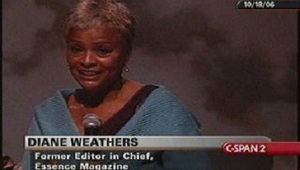
FORMER ESSENCE MAGAZINE EDITOR DIANE WEATHERS REMEMBERED ALONG WITH STEPHANIE STOKES OLIVER AND DION E. CLARKE. |
By: Richard Prince, Journal-isms N2Entertainment.net
N2Entertainment.net
Stephanie Stokes Oliver and Diane Weathers, two editors of Essence magazine during the 1990s and early 2000s, died in July without benefit of full-fledged obituaries in the media, but colleagues have taken to social media and the internet to give them their props in the way they know best.
Weathers, 76, editor of the magazine from 2001 to 2005, died July 8 at her home in the Washington suburb of Silver Spring, Md. The cause of death has not been determined, her brother, Ronald Weathers, told Journal-isms.
Weathers--a Journal-isms supporter was married for a time to Ronald Smothers, a former reporter for The New York Times and Washington Post who died in April--was editor when Essence launched its "Take Back the Music" campaign.
That effort was launched to raise awareness of "the degrading ways in which Black women are portrayed and spoken about in popular media, particularly in popular urban music and music." One of her Weathers' first initiatives was a series called "War on Girls," about young Black girls and their challenges, an issue particularly important to Weathers because she had an 11-year-old.
Another was "Our Bodies, Ourselves," which discussed health issues. It "became very intimate" as she discussed her own weight challenges with readers, Michelle Ebanks, president of Essence Communications Partners, said. "I don't know another editor who was so transparent."
Weathers "taught me to have a passion for the arts," Cori Murray, an entertainment editor under Weathers, wrote on Instagram. "Under her leadership, I hit some pretty sharp learning curves as I found my rhythm as a writer and editor. One vivid memory-- and in hindsight a pivotal lesson in covering culture for a national audience-- she vehemently insisted I think beyond what the cool kids were into because 'not everyone is in Brooklyn.' She was right.
"I reluctantly went on a journey of discovering the otherness Diane spoke about or what she regularly scribbled as line edits on my copy. She recommended artists, writers, genres, musicians, curators and exhibits I should know intimately. She pushed me to think bigger. She introduced me to new voices, new experiences. She threw open a window to [a] world that I've since leaped through, enjoying the discoveries being curious brings."
When she stepped down, Keith Kelly wrote in the New York Post, "She's had a stormy tenure, with at least a half dozen top editors heading to the exits in the past year."
But Weathers told an interviewer, "I'm leaving for personal and professional reasons. I'm going through some things with my family and I really need more time to focus on them. I don't have the energy to really put the attention that I need into the magazine. I need to focus on family issues."
Ebanks told Journal-isms at the time, "Women need this type of professional flexibility given the often competing demands of work and family--no matter the timing."
Weathers told Target Market News, "I'm proudest of the quality of the magazine. I think it has never been better, I'm proud of our campaigns, The War on Girls, Saving Our Sons and now Take Back The Music. And I'm proud of our numbers--our newsstand sales are up at a time when many women's magazines have been suffering on the newsstands."
STEPHANIE STOKES OLIVER:
Stephanie Stokes Oliver, a top editor at several magazine publications, Essence included, died two days later, on July 10, in her Seattle hometown due to complications following a long illness. She was 74.
"I was just dancing and celebrating with my friend Reggie Oliver at his surprise 80th birthday celebration," Harriette Cole wrote July 30 for the Root. "His wife, Stephanie Stokes-Oliver, former executive editor at Essence, had not made the trip to East Hampton from Seattle, WA, as she was under the weather. All indications were that she would be okay.
"Fast forward a few weeks, when I learned Stephanie (Stokes-Oliver) had died. No. This woman-- this sweet, smart, thoughtful, intellectual soul sister-- was gone. The person who gave me a chance when I started my career, who hired me to work with her in the Contemporary Living Department at the beacon of culture for Black women, had left the planet. No. Of course, people have to leave, but Steph? She had lived her best life, building a stellar career at Essence, retiring with her husband to Anguilla to start a new chapter, and moving back to Seattle to care for her mother, Miss Josephine, who outlived her at age 101. She was forever. No?"
During her 16 years at Essence, when the magazine reached the milestone circulation of 1 million, Oliver rose to West Coast editor, and to the second-in-command position of editor of the magazine. In 2004, she was asked to assist in the merger of initially Black-owned Essence Communications with Time Inc., returning to the company for the second time, as editor-in-chief of Essence.com.
Oliver, a top editor at several magazine publications, began her storied career as a college guest editor for Glamour magazine back in the early seventies when young Black college women aspiring for magazine careers were rarely selected for one of the industry’s most prized early recognitions.
An HBCU graduate of Howard University in 1974, Oliver began her professional magazine career at Conde Nast publications as a "roving editor" working in the departments of the company's many publications, including Glamour, giving her an education in all facets of magazine publishing.
Essence Editor-in-Chief Susan L. Taylor asked Oliver to return to Essence as editor in 1987, the second-in-command position to the editor-in-chief. When the renowned health publisher Rodale Press decided to launch "Heart & Soul," the first magazine geared to covering the health issues of African Americans, it hired Oliver away from Essence in 1994 to be the publication's founding editor-in-chief.
Oliver would hire and develop a stable of health writers that included the highly respected medical writer Harriet A. Washington, a prize-winning and best-selling author of books on Black health. "Heart & Soul" was nominated for a "Best New Magazine" Award by Folio magazine, a magazine industry publication. In 1998 Oliver formed SSO Media, an international consulting firm that specialized in book, magazine and digital publishing.
Oliver's own magazine career dovetailed with a successful career as a book author. "Daily Cornbread," her first book, published in 1999 by Doubleday, was a clever spin on the "Daily Word" book meditations published by Unity Publishing. "Daily Cornbread," however, gave daily affirmations specific to Black women for leading a balanced life. Oliver's other books include "Seven Soulful Secrets," "Song for My Father," and "Black Ink." She was working on a book about the magazine industry at the time of her death.
In 1999, Oliver relocated from the East Coast with her husband to the tiny Caribbean island of Anguilla, where they had long dreamed of retiring. Yet Oliver continued her magazine career, serving as VP of Publishing at Unity Publications, the first person of color named to head the company's important division of books related to spiritual and personal development. She would divide her time between living in Unity Village, Missouri, Unity's headquarters, and her island home of Anguilla.
In short order, Oliver became a literary force on her adopted island, helping to launch the celebrated Anguilla Literary Fest, an annual gathering of some of the most important authors, agents and publishers, who ran panels and workshops and how-to lectures for aspiring writers.
Oliver's invaluable contacts and good relationships in the media community were able to attract such literary stars to the festival as novelists Alice Walker, Colin Channer and Benilde Little; the mystery writer Valerie Wilson Wesley, her husband, screenwriter Richard Wesley, Dan Brown, author of the best-selling "The DaVinci Code", and Dawn Davis, VP and senior editor at Simon & Schuster.
DION E. CLARKE:
In addition to Stokes-Oliver and Weathers, colleagues are mourning another Essence alum, Dion E. Clarke, who died July 13 after a battle with pancreatic cancer. He was 72.
Clarke "was on the sales team at Essence in the late '90s,"Cole wrote. "He worked alongside Clarence Smith and Barbara Britton, hustling hard to convince brands to invest in a company that celebrated Black women.
"Even though Essence was the top Black magazine then, one million subscribers strong, it was still hard as hell to attract companies that remained incredulous that Black folk wielded so much economic power.
"As an alum, Dion set his sights on the Harlem Fine Arts Show (HFAS) 19 years ago, turning a business that started at the Puck Building in NYC into a traveling art show featuring Black fine artists. Dion loved Black people and believed at his core that our creativity, energy, and dedication were immeasurably valuable. He died four days before HFAS in the Hamptons opened its doors."
EDITOR'S NOTE: Washington Post journalist Richard Prince occasionally submits his column "Journal-isms" to "Media Matters." Prince's "Journal-isms" originates from Washington, D.C. To check out Prince's complete "Journal-ism's" columns log on to: http://mije.org.
|


